Blog Feed

Bird

Piping Shrike or Magpie-lark?

Theme: Aves, Nomenclature, Factual, Birding.

Reading Time: 10 minutes.

Please subscribe to receive my latest posts about nature & science straight to your email inbox. 🌏👩🏽‍🔬😀

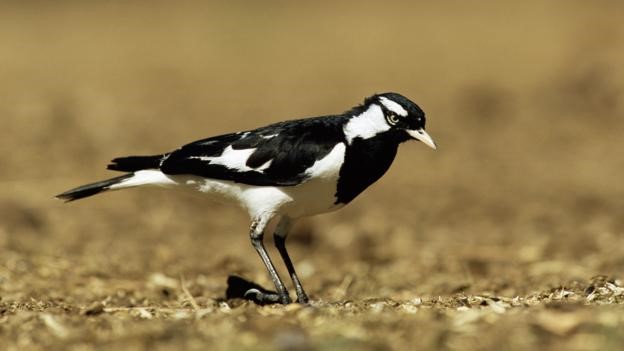
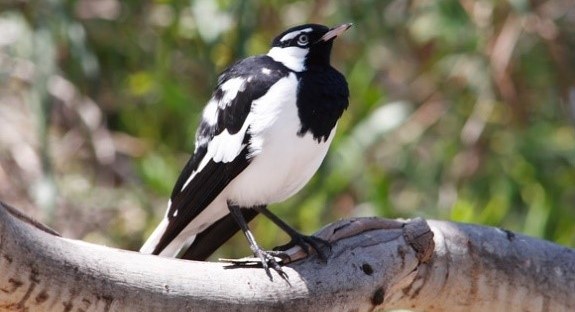
I ask you, what bird is this?

Image result for magpie lark

Source: http://www.bbc.com/earth/story/20160803-the-strange-reason-magpie-larks-dance-when-nobody-is-looking

If you answered, “that’s the piping shrike!”, well, I’m sorry to say my friend, but you are incorrect!

I will present the evidence and explain the confusion below.

Confusing one thing for another is in no way uncommon. Like mistaking a massive hare for a rabbit, fearing poisonous snakes that are actually venomous, or even naming many sea creatures “fish” such as jellyfish, starfish or cuttlefish, all of which are not really fish at all.
Educator? Or, perhaps you know one? Hit this link for Free Australian Curriculum Aligned Videos!

But if an animal is on your state flag, is it acceptable not to know it when you see it?

I refer to the Australian magpie (piping shrike) which is on my state’s flag, the flag belonging to the state of South Australia. If such an animal appears on your state flag you should know what that animal is… shouldn’t you?

Well, unfortunately, that is not the case here.

A few months back I was at work one night and was visited by a friend who pops in now and then to say hello. He is usually quite stealth, and no one really notices when he’s around. He just quietly drops in to have a nosey when the time is right.

Now, I admit, he doesn’t come in just to see me, I believe for the most part he is just checking to see if any birdseed bags have been split open on the back dock with the hope of getting a belly full of free food.

Yes, my friend eats birdseed, and he loves it.

Those with a scientific background or an interest in birds may know him more specifically as Grallina cyanoleuca, and I know it’s a “him” as he has thick white eyebrows (a distinguishing male phenotype). My pied little friend has become quite the regular, and I am always happy to see him pop in looking healthy and happy, even though he clearly only visits me for his own benefit.

One night when at work, my white-eyebrowed and pied friend dropped in to say hello. As I had been practising the scientific names of birds at the time, I proudly announced to my comrade “Grallina cyanoleuca” as I pointed to our petite visitor.

“What does that mean?” my colleague replied.

I quickly explained that I was practising the scientific names for our local birds and the words I had just announced were the scientific names (genus and species) given to that bird, the magpie-lark.

He was quick to laugh at me, “that’s not a magpie-lark mate, that’s the piping shrike” he said smugly.

Well, I was just learning, so unconfident at the time I dare not argue my point and thought maybe he knew more than I did. So, I carried the doubt with me for the rest of my shift.

Once home I was straight to my computer to do some research and find out where I had gone wrong. I was delighted to find that I was not mistaken and in fact, the bird friend who was visiting me earlier at my work was the magpie-lark (Grallina cyanoleuca), not a piping shrike.

That was not to be the last time I was filled with doubt surrounding this issue.

A few months later, as little as 1-2 months ago, while walking my dog Bruce around our neighbourhood, I was lucky enough to notice what I suspected was a magpie lark in a nest. The pied bird had built a mud nest which sat upon the vertical branch of a bottlebrush tree. This bird was sitting stationary and only moved away for a moment when it noticed me and my pooch standing below looking up and admiring. But it was quick to return once I strayed a few meters further down the street and took up a different position to see what it would do. I returned and again it flew away. A precautionary method obviously as once I strayed afar again it immediately returned to its nest.

From the behaviour observed, and the quietness of the nest when the bird was not within it, I correctly assumed it was incubating a clutch of eggs and for the next week or so when I walked my dog under the same bottlebrush tree, I observed the same behaviour.

Until 1 day when I could hear chirping from within the nest which must have been hatchlings. I was delighted to observe this occurrence just on the verge of spring and was sure to keep an eye on the situation for the next few weeks.

Over the next 2-3 weeks, I observed mother and father swapping on the nest, taking it in turns to gather and return with food, and the increasing size of each of the three chicks of the brood. This carried on much to my pleasure until one day I returned, and the nest was empty, with no adults, no chicks and no evidence of any foul play. So, I can only assume a happy ending to that story.

However, if I rewind the clock a week or so to a bright and sunny day when I was standing at a distance and observing this soon-to-be bird family’s behaviour, I recall a moment that caught me off guard.

“What are you looking at?” a voice would say from over the road.

I looked over to see an older woman who must have been in her 60’s or 70’s, who had stopped her mobility scooter on the footpath directly across the road from where I stood so obviously intrigued. She was staring at me staring at something within the tree.

“What have you found love?” she repeated as she gently stroked a small dog which sat upon her lap.

“A magpie-lark feeding her brood” I replied confidently, enjoying the opportunity to show off my newfound expertise.

“Magpie-lark?” she seemed puzzled.

“Yes, a magpie-lark, you know, it looks like a magpie, only smaller and more petite” I responded.

“Oh, you mean a piping shrike” she replied as she began on her way again.

“Pretty common this time of year” she announced as she drove off down the street.

Once again, I was left questioning myself, although this time I was slightly more confident I was correct.

I headed home again and immediately researched the magpie-lark and piping shrike, and I was right, only this time I was slightly happier as I was growing ever more confident in my identification of the bird.

The magpie-lark, also known as the peewee or peewit (after the sound of its distinctive calls), mudlark, murray magpie, and ever more commonly and mistakenly as the “piping shrike”, is a passerine bird which is native to Australia, Timor and southern New Guinea. Importantly I reiterate, the magpie-lark (Grallina cyanoleuca) does not appear on the South Australian flag and is not a “piping shrike”.

In fact, to add more confusion to the matter, the magpie-lark (Grallina cyanoleuca) is not a magpie, or a lark, and is actually more closely related to Monarchs, Fantails and Drongos. However, In 1977, the Royal Australasian Ornithologists Union (RAOU) settled on Australian magpie-lark as the official name, noting that the names magpie lark and, less commonly, mudlark were used in guidebooks at the time.

It is easy enough to distinguish between a mature male and a mature female magpie-lark as the adult male has a white eyebrow and a black face while the adult female has an all-white face with no white eyebrow.(1)
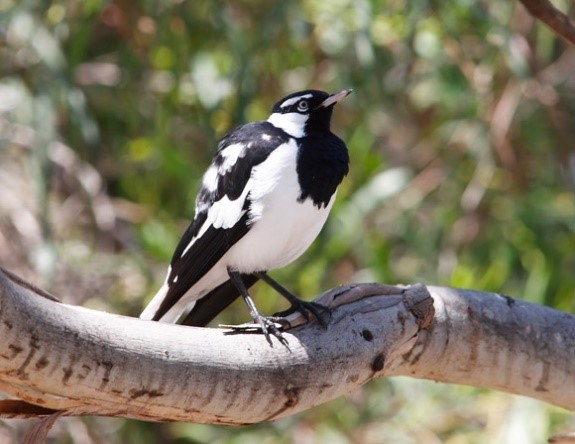
http://www.birdlife.org.au/images/sized/images/uploads/bird_profiles/magpie-lark-ct580-580x448.jpg

Image: A male magpie-lark with the clearly visible white eyebrow.

Source: http://www.birdlife.org.au/bird-profile/magpie-lark
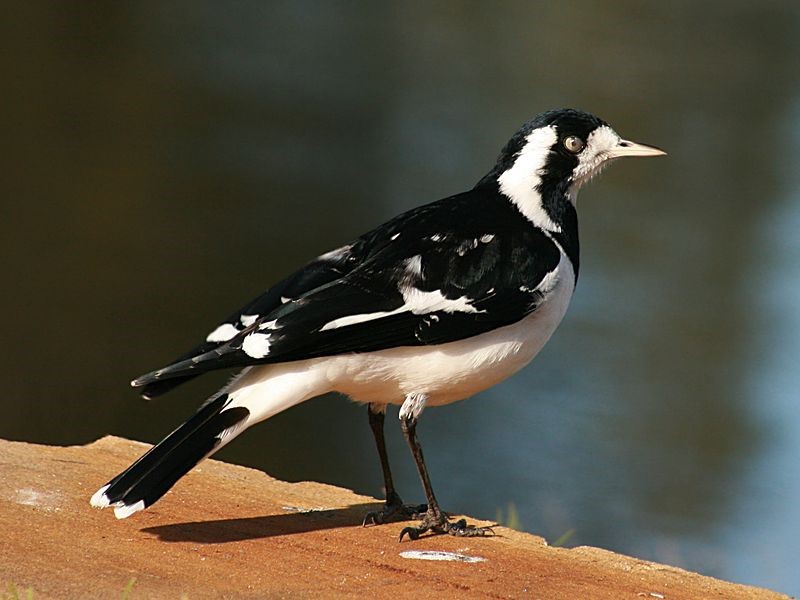
File:Magpie Lark female.jpg

Image: A female magpie-lark with no white eyebrow and a white face.

Source: https://commons.wikimedia.org/wiki/File:Magpie_Lark_female.jpg

However, while distinguishing male magpie-larks from females seems relatively easy, distinguishing the magpie-lark itself from the piping shrike (Australian magpie) seems to be an area of much confusion amongst everyday Australians and more specifically my fellow South Australians.

This erroneous way is largely in part due to the nickname “piping shrike” not technically used to identify any bird, and due to this a lot of confusion has resulted over what bird the term represents. While some think it refers to the magpie-lark (Grallina cyanoleuca), the actual original reports specify that it is based on the Australian magpie.(2)
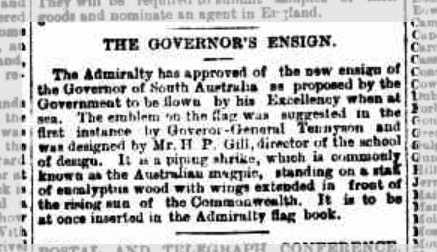
Image: THE GOVERNOR’S ENSIGN. – The Sydney Morning Herald (NSW : 1842 – 1954) – 16 Mar 1903.

Article reads;

“THE GOVERNOR’S ENSIGN.

The Admiralty has approved of the new ensign of

the Governor of South Australia as proposed by the

Government to be flown by his Excellency when at

sea. The emblem on the flag was suggested in the

first instance by Governor-General Tennyson and

was designed by Mr. H. P. Gill, director of the school

of design. It is a piping shrike, which is commonly

known as the Australian magpie, Standing on a staff

of eucalyptus wood with wings extended in front of

the rising sun of the Commonwealth. It is to be

at once inserted in the Admiralty flag book.”

Source: https://trove.nla.gov.au/newspaper/article/14568342?browse=ndp%3Abrowse%2Ftitle%2FS%2Ftitle%2F35%2F1903%2F03%2F16%2Fpage%2F1335271%2Farticle%2F14568342

Government sources also support this claim and state;

“The State Badge of a piping shrike (also known as a White Backed Magpie), was notified by a proclamation gazetted on 14 January 1904. The original drawing of the piping shrike was done in 1904 by Robert Craig of the School of Arts. A later drawing was done in 1910 by Harry P Gill, who was the Principal of the School of Arts”.(3)

Now, let me show you, this is the South Australian flag (below). It features a white-backed Australian magpie (piping shrike) perched on a staff of eucalyptus and facing the rising sun.

Image result for south australian flag

Image: The South Australian Flag.

Source: https://www.britannica.com/topic/flag-of-South-Australia

As you can see it has no white eyebrow and no white face, so it is not the magpie-lark, and you can tell we are viewing its back as the claws which grip the eucalyptus staff are facing the sun with the back claw visible and its 3 front-facing claws hidden. Therefore this can only be a white-backed magpie (piping shrike).

And this is a photo of the white-backed magpie (piping shrike).
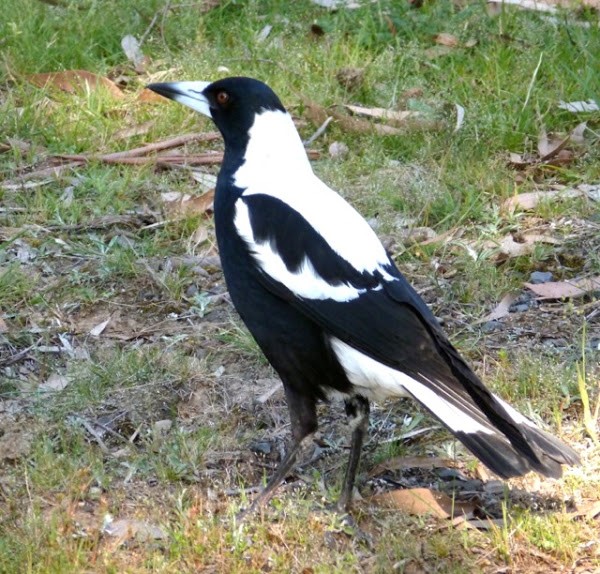
Image result for gymnorhina tibicen leuconota

Image: White-backed magpie (piping shrike).

Source: https://www.projectnoah.org/spottings/15841184

Below is the magpie-lark. Or the peewee, peewit, murray magpie or mudlark as it is called, and importantly, this is not a piping shrike.
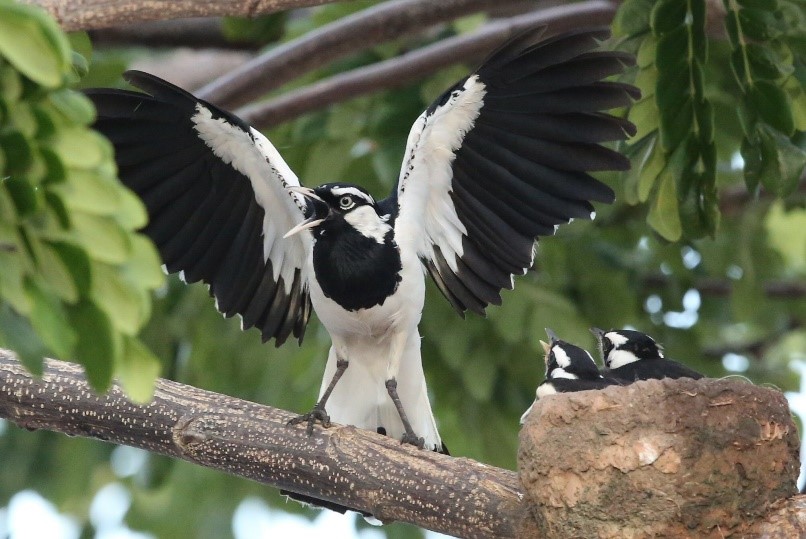
Image result for magpie lark

Image: A male magpie-lark next to his nest and brood of two chicks.

Source: http://members.ozemail.com.au/~bajan/Magpie-larks/Magpie-lark%20or%20Peewee.htm

You can see why it is easily confused with the back of the piping shrike (Australian magpie) on the South Australian flag, as this bird in the image, the magpie-lark, looks very similar.

So, now you know, once and for all, the piping shrike is the large Australian magpie who is also featured on the South Australian flag, and the piping shrike is not the petite magpie-lark.

Next time you see someone call the smaller petite passerine bird the piping shrike you can tell them that the bird they refer to is the magpie-lark and the piping shrike is a term that refers to the much larger Australian magpie.

If they don’t believe you, refer them to this article.

Hope I helped clear that up for you.

Check out my future posts and articles and subscribe below and if you have any questions don’t hesitate to comment at the bottom of this page or on my Facebook feed and I’ll be sure to answer you straight away.

Thank you and enjoy,

W. A. Greenly.

W. A. Greenly’s upcoming articles include:

  • How to Train an Environmentalist.
  • The Mystery of the Australian Megafauna.
  • Recycling Made Simple.

Literature cited:

  1. http://www.carterdigital.com.au, C. (2019). Magpie-lark | BirdLife Australia. Retrieved 21 November 2019, from http://www.birdlife.org.au/bird-profile/magpie-lark).
  2. THE GOVERNOR’S ENSIGN. – The Sydney Morning Herald (NSW : 1842 – 1954) – 16 Mar 1903. (2019). Retrieved 21 November 2019, from https://trove.nla.gov.au/newspaper/article/14568342?browse=ndp%3Abrowse%2Ftitle%2FS%2Ftitle%2F35%2F1903%2F03%2F16%2Fpage%2F1335271%2Farticle%2F14568342.
  3. Using the state insignia and emblems. (2019). Retrieved 21 November 2019, from https://www.dpc.sa.gov.au/responsibilities/state-protocols-acknowledgements/using-the-state-insignia-and-emblems.
Poem

Where Do All The Snails Go? A poem by Mr. Greenly

Theme: Poem, Creative, Artistic.

Reading Time: Less than 1 minute.

Where do all the snails go?

When I walk around at night,

Once my eyes adapt to less light,

I see some thin and shiny trails,

If I follow, I find some snails.

In the morning, when the sky is bright,

There’s not a snail to be seen in sight,

As if they all just flew away,

Snails are hard to find in the day.

I look around where I’d seen them last,

They can’t have gone far, snails aren’t very fast.

I see some ants, some birds and a mouse,

But where is that slimy snail’s house?

Maybe you can help? Do you know?

Where do all the snails go?

Written by W. A. Greenly

W. A. Greenly’s upcoming articles include:

  • The Mystery of the Australian Megafauna.
  • Recycling Made Simple.
  • Piping shrike or magpie-lark?

Introduction

Finding Nature, a True Adventure – Long Bio

Theme: Sample (Environmental, Creative, Factual, Adventure, Opinion).

Reading Time: 20 Minutes.

Please subscribe to receive my latest free readings and my posts about nature & science straight to your email. 🌏👩🏽‍🔬😀

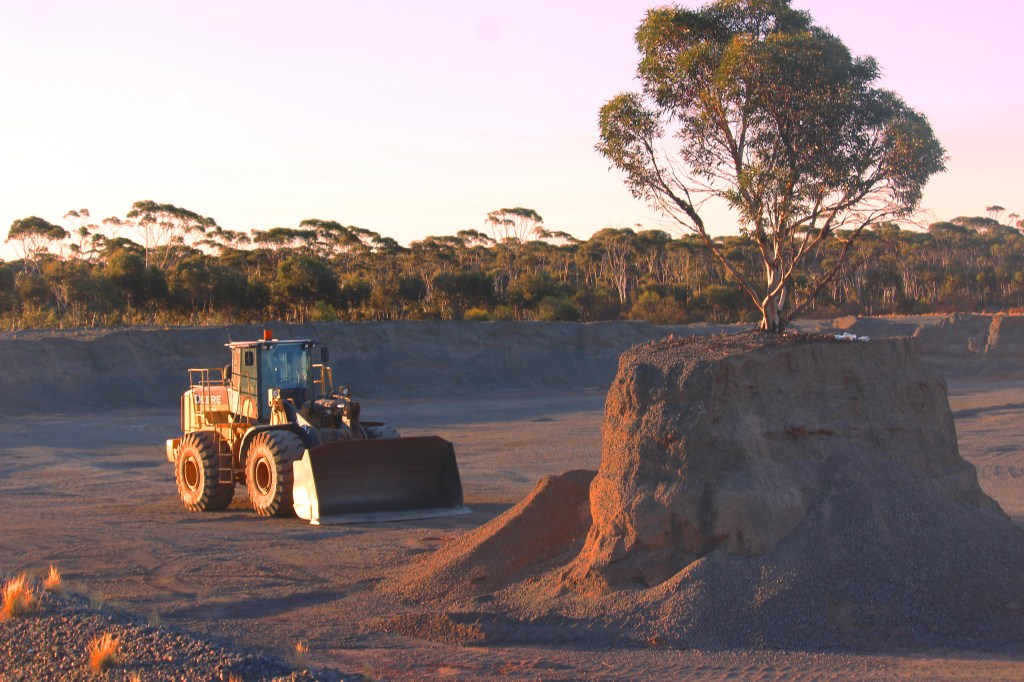
Conundrum? A digger-truck-driver has a decision to make in a gravel trap, Western Australia (W. A. Greenly).

Hey,

I’m W. A. Greenly,

Mechanic/Salesman turn science geek, Earth lover, and opinionated writer who now has a Bachelor’s Degree in Biodiversity and Conservation.

If you read my last blog, then you have already been briefly introduced to me. However, in this article, I intend to give you a much more in-depth story explaining why I am here, how I got here and what I’ll be covering in my future pieces.

First off, let me paint a picture for you.

If I say to you, there’s a country that boasts the world’s second-oldest national park, namely Royal National Park(1), a country that has 3.3 million square kilometres (36%) of its oceans zoned as marine parks(2), and this country encompasses a range of contrasting yet beautiful terrestrial and marine ecosystems that at one stage were bursting with an abundance of native wildlife… Would you know what country this is?

Let me elaborate; this country also has tropical savannas, coastal floodplains, coral reefs, drier rainforests, and inland wetlands(3). It features Mediterranean ecosystems in the southwest, temperate eucalypt forests scattered throughout, plus salt marshes, mangroves(3) and 8,222 islands(4) each of which is host to its own unique ecosystem. Yet, this is only to skim the surface of its true ecological depth.

How about now, think you know it?

If you grew up here like me, I’d suspect you guessed the country I was referring to quicker than seagulls to an unguarded lunch.

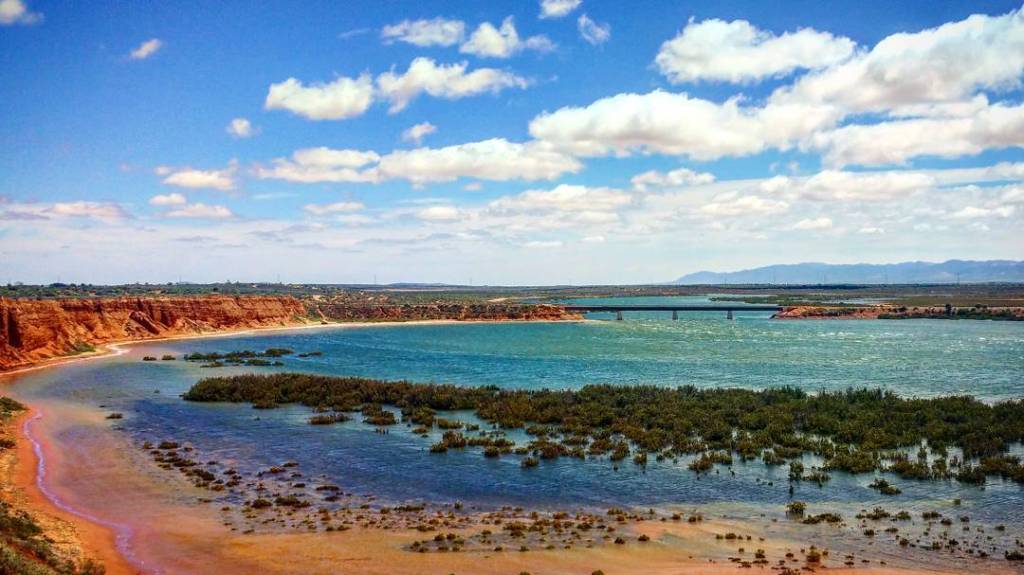
Matthew Flinders Red Cliff Lookout, Port Augusta, South Australia (W. A. Greenly).

Australian memories:

I grew up here, Australia. As a young boy, I vividly remember the streets lined with Eucalyptus, Callistemon, and other native trees, that when flowering delicately littered the asphalt with crumbling leaves, colourful filaments, and rock-hard gumnuts that were never pleasant to trod on in bare feet. Whispers of the legend himself Bob Hawke, the beer ‘skulling’ environmentalist prime minister who declared the 1990’s the “Decade of Landcare”. Watching and singing along to “Skippy the Bush Kangaroo” on the Nine Network before school and then admiring mighty Steve Irwin wrestling crocs and harassing snakes in the arvo while we ate tea.

It’s quite easy to reminisce about a time when life for me was carefree and “responsibility” was just a word that I heard grownups say. But what’s happening now?

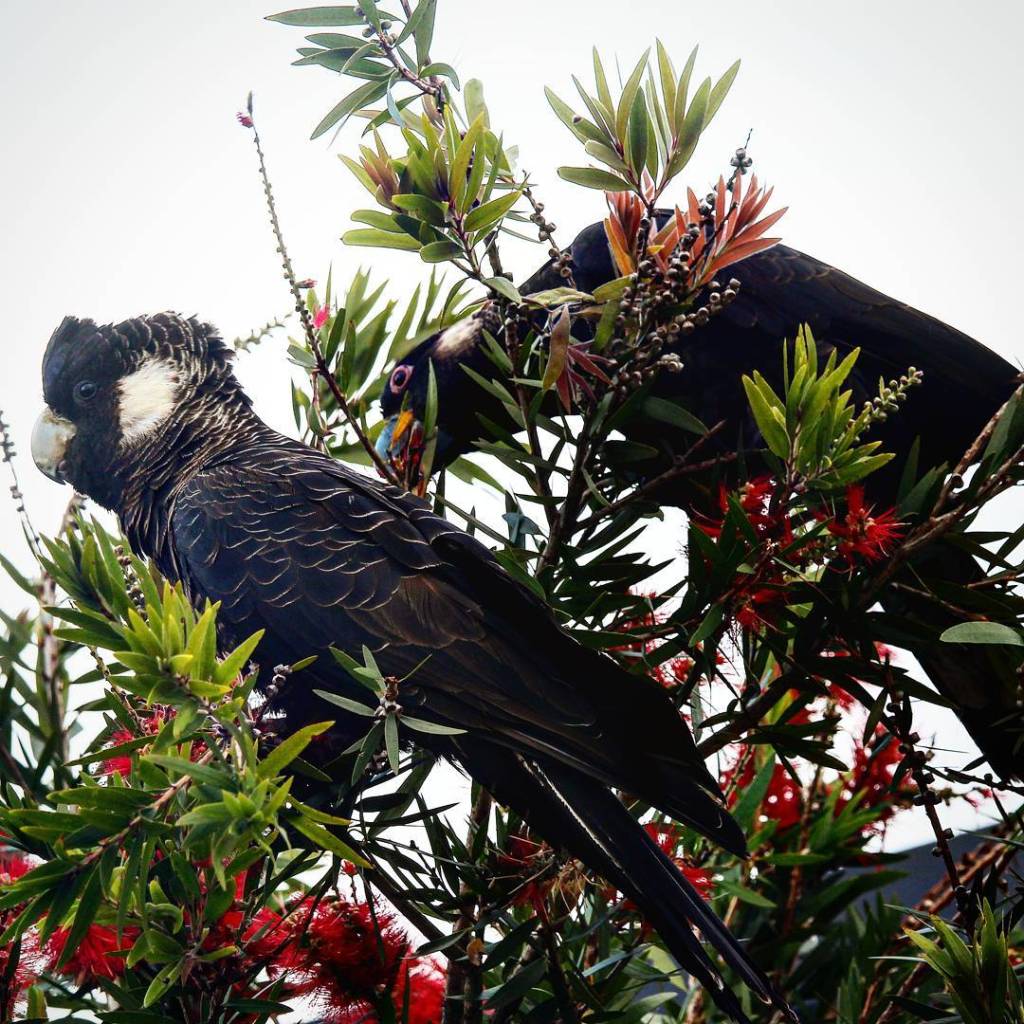
Two black cockatoos perched amongst Callistemon near Nornalup, Western Australia (W. A. Greenly).

The present:

Well, as you know mankind is facing one of the most gruelling challenges to have confronted us in the twenty-first century, climate change(5). The debate surrounding climate change in Australia is most certainly alive and well, as it should be in any country.

Various independent studies affirm that the climate change currently occurring is anthropogenic, that is, caused by humans, and over 97% of climate scientists agree on this(6;7;8;9;10).

Yet, currently, the primary energy consumption of Australia is still supplied by coal (around 40% as of 2019)(11) and despite the imminent threat of climate change, in the 2017-18 financial year Australia exported around 382 million tonnes of black coal. A figure that has been growing on average by 4% a year over the last decade(12).

Currently, 91 species of Australian flora and fauna are listed as extinct, plus 1 fish species Galaxias pedderensis is listed as extinct in the wild(13;14). While another 1790 species of Australian flora and fauna are listed as being either vulnerable, endangered, or critically endangered, with a further 8 fishes currently listed as conservation dependent(13;14).

According to the International Union for the Conservation of Nature (IUCN), the main drivers of biodiversity loss are:

  • Habitat destruction (on land and at sea).
  • Resource overexploitation.
  • Climate change.
  • Pollution.
  • And invasive species(15).

Australia is in no way a stranger to these driving issues; land clearing rates in Queensland tripled in the years 2013-2014 when compared to 2009-2010(16). Invasive species and feral animals are continually exerting more pressure on Australia’s biodiversity and the fragmenting and degradation of habitats is ongoing(16).

Sadly, the overall outlook for Australia’s biodiversity is very poor(16).

Not to mention that as of October 3rd, 2019 the population of Australia exceeds 25.4 million, a figure that in 1995 was just 18.1 million(17). Now, an increase of 7.3 million may not seem like much in the grand scheme of things, but an increase of just over 40% within 24 years is quite a substantial jump. On a global scale, the world population is 7.6 billion(18) and is predicted to reach 11.2 billion by 2100(19), another worrying increase of well over 40%.

Yet, despite the population growth history, the predictions, and the undeniable fact that human population growth adds further pressure to all the drivers of biodiversity loss, the pressures of local and broad-scale population growth are barely heard amongst any climate change or biodiversity loss commentary.

So, we have just touched on climate change, carbon emissions, coal exports, energy production, species extinctions, the drivers of biodiversity loss, the poor outlook for the future, and I’ve even slipped in some population growth figures and predictions. But to be brutally honest, the above-mentioned issues and facts aren’t even skimming the surface of the current environmental issues that face the world or Australia.

Why do I care?

In some way, all those pressing issues continually drive me to seek answers and explore our natural world, but if it wasn’t for one special moment in time they may not have been on my radar at all.

Let me explain.

As you likely already know, little over 12 months ago I was employed as a qualified Mechanic and Service Advisor spending my time in a dirty old workshop waiting for the next broken-down car to be towed in so I could try and make my next big sale. The closest I would get to the environment between 8 am to 6 pm every weekday was the all-too-familiar tree that was visible when I caught a glimpse of the outside world through the garage door of the workshop, or the dirt that would fall off the worn tyres of a customer’s sad sounding European import when removing the wheels to check the brakes.

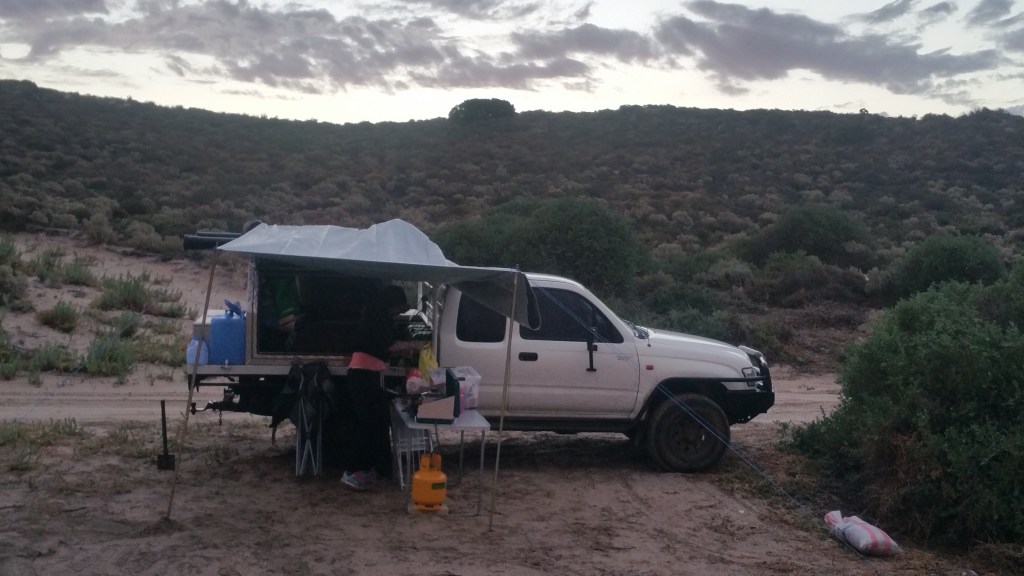
If it wasn’t for my decision to take a month off work, stack the Hilux sky-high with camping and 4×4 gear, and head off from Adelaide across the Nullarbor to Perth, I may have never realised my true passions and how freedom and happiness truly felt.

Shelter up just in time for the rain and dinner prep at Yalata Beach Campground, South Australia (W. A. Greenly).

This trip may not sound like much to some, but to me, it changed my life forever.

Overall the trip taught me that if you dare leave your comfort zone, life will reward you, and there’s certainly more to life than working a 9-5 and looking after only your own interests.

But 3 Key moments stick in my mind that completely changed my mindset and opened my eyes.

The Iconic Nullarbor Roadhouse, Eyre Highway, Nullarbor, South Australia (W. A. Greenly).

Key moment 1: “Schooled by Snakes”.

Ok, so perhaps this is not really one key moment, more of 3 key moments involving snakes… but I’m going to group them all together.

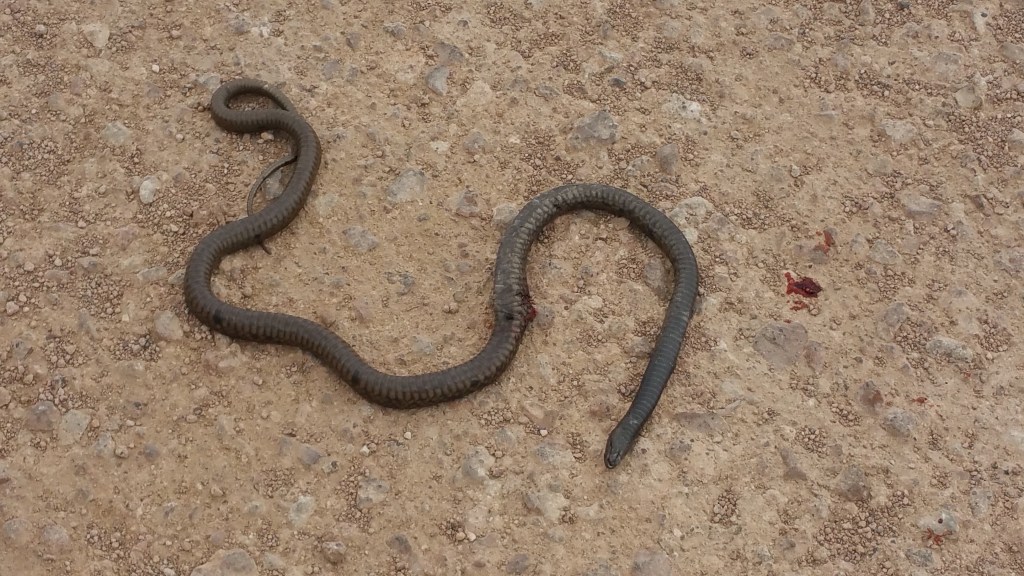
I’d never properly seen a snake in the wild, so when I took this trip across the Nullarbor, I was eager to spot one. My first sighting came only a few days into the trip, just one kilometre out of Fowlers Bay, South Australia. As I was travelling toward the town on a dirt road, I saw a thin black figure scoot out of the bushes and straight underneath my car. I was shocked, saddened, and absolutely devastated once I had confirmed it was my first snake sighting and I had accidentally run it over. I carried the burden for days. The death of this snake made a lasting impression on me and confirmed my love for animals of all kinds.

The unknown snake that sadly became roadkill near Fowlers Bay, South Australia (W. A. Greenly).

Luckily, that was not to be my only experience with a snake.

One morning I headed off towards the Fitzgerald River National Park which is on the coastline just west of Hopetoun, Western Australia. I happened to look up at the sky above me and noticed a cloud had formed into a weird hook shape. Simultaneously, I noticed an almost identical hook-shaped piece of land appear on my GPS and it was very close by.

It seemed as if it was a sign of some kind, so I pulled over and explored.

As I ventured toward the tip of this mini peninsula, I could see a small wooden bird-watching hut at the very end, only about 50 metres away. I don’t exactly know why, perhaps instinct, but something made me look down just as I stepped over a long, thick, brown snake that was curled up on the path and watching me with caution.

It just sat watching me, slightly covered with some grasses for camouflage but for the most part allowing its thick smooth and scaly body to bask in the sun and soak up some much-needed energy.

Wow… a snake, an alive snake, and what an odd situation that had led me to find it.

I was very happy to say the least, but at the same time, I was kind of scared. What if it decided it wanted to attack me? Australian snakes have an infamous reputation. I snapped a quick photo on my phone and continued along the path respecting the snake’s space.

Upon my return, the snake had disappeared.

I learnt 2 things that day:

  1. If you get out there and amongst it, nature will reward you.
  2. Snakes are not out to get you, they are just trying to survive and will, like most animals, avoid conflict if they can.
Bad phone photo of the scary snake watching me near Fitzgerald River National Park, Western Australia (W. A. Greenly).

I had another and perhaps more memorable experience with a snake on this trip whilst practicing my photography at Greens Pool and Elephant Rocks, Western Australia.

I was drawn towards 2 enormous, bulbous rocks that sat oddly in the middle of the beach. Eventually, my curiosity overcame me, and I followed a thin trail of water from where it met the ocean to its source up in between the 2 oddly placed rocks.

Suddenly I was startled, my heart skipped a beat and I paused for a second not knowing what to do.

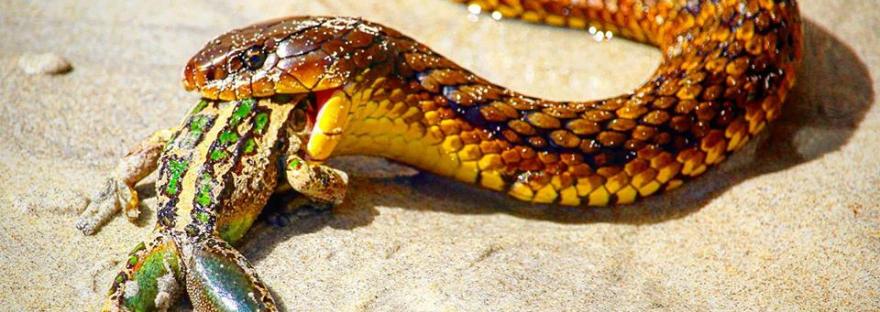
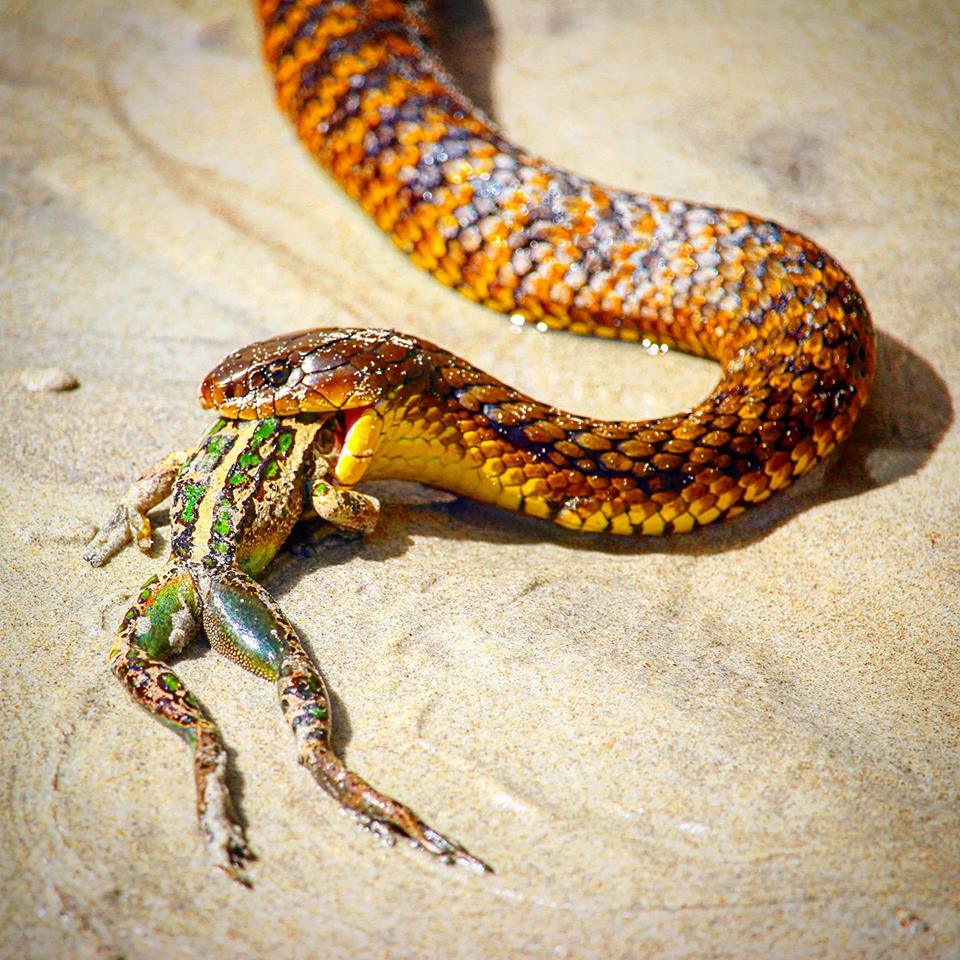
A beautiful tiger snake had also paused, possibly shocked, it too not knowing what to do. It stared at me, and I stared back at it, each awaiting the other’s move.

Slowly, the snake began creeping forward, reaching for something a few feet in front of it – a large green frog, semi-limp but still kicking slightly. The snake had obviously determined at this stage that the frog was too much of a prize to pass up and I was obviously not enough of a threat. So, it began again from where it had left off before I’d rudely interrupted its lunch.

I just watched this snake, mesmerised. It was like nothing I’d ever seen before. It had the most striking yellow and brown horizontal stripes running across its body. The colourful scales shimmered and glistened in the sunlight. Although now sadly passed, its meal too was beautifully coloured with bright greens and creamy yellows. But the snake’s eyes never left me and it watched me the whole time while slowly consuming its slippery meal.

I must have snapped about 100 photos before the snake had finished and eventually slipped away, disappearing behind a boulder and into the bushes.

A complete adrenalin shot, and all while I felt 100% safe.

That was it, the moment I fell in love with exploring nature.

Actual photo of the gorgeous tiger snake that took my breath away on the beach at Elephant Rocks, Western Australia (W. A. Greenly).

Key moment 2: 1080 (ten – eighty) baiting.

As I travelled towards Beedelup National Park Western Australia, I noticed some signs along the road that reported “1080 baits used in this area” and “Be aware, 1080 baiting”.

I was somewhat aware of 1080 baiting which is why I chose not to take my dog Bruce, especially seeing as this was my first real adventure so I didn’t know what to expect.

However, the signs don’t tell you much, they are simply a warning to people with dogs or possibly children that there is a risk they may come across a 1080 bait in these areas. Fairly mundane and un-informative really.

That night I lay in my swag, mosquito net closed, peering out at the stars above which flickered beyond the swaying trees listening to the many birds calling to one another against the sound of the soft winds and the rustling of leaves, and I questioned… What exactly is 1080 baiting?

I admit, that night I committed a cardinal sin when it comes to enjoying nature, I whipped out my mobile phone and began to do some research.

I will not go into too much detail in this article, but I will say I was shocked to find out what these baits do, whom they target, and the inhumane way in which they kill. Not to mention the little amount of research that has gone into it from an ecological point of view.

The implementation and longevity of this baiting scheme taught me there are animals out there that need help, voiceless animals that are targeted by certain industries or individuals who ultimately are unnecessary victims of humanity, or inhumanity as it seemed.

At that moment, I realised there’s more to life than doing oil changes or trying to up-sell windscreen wipers to Joe Blow. There are innocent and forgotten animals and whole ecosystems that desperately needed assistance, the health of which we all ultimately rely upon.

Bruce, my dog, who sadly missed out on this road trip (W. A. Greenly).

Key moment 3: True Freedom.

Never have I felt the freedom I felt after travelling alone, just me, the road, my hiking boots, and nature. Once a few weeks had gone by, I had not a care in the world, no stress, no idea of the time or date, no restrictions at all. I was completely free, and the feeling was almost indescribable.

If I had to put it in a few words I’d say; enriching, addictive, euphoric.

I was ultimately high on life at those moments.

I think this feeling made me realise how and what life could truly be, rather than what it currently was.

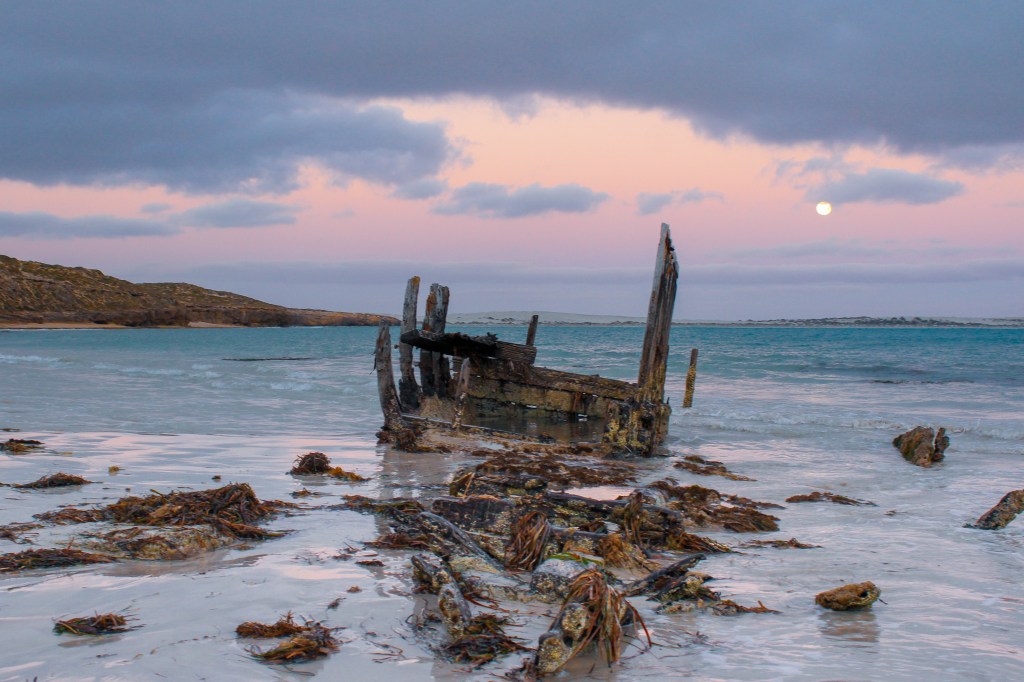
Cecelia’s wreck rests on the beach at Port Le Hunte, South Australia, as 2016’s super-moon is illuminated by the sun which sets behind me (W. A. Greenly).

Back to my false reality:

Sadly, that trip came to an end, and I had to return to work… but it was not the last, and I have many more to come.

At that time of my life, I was buried in debt, 28 years old with a mortgage, car loan, and all the usual bills. Trapped again, working a job I now knew was not where I wanted to be for the rest of my life.

So ultimately, I had a decision to make. Follow the social norm and slave away at a job I most certainly did not love to pay my debt down for the rest of my life?

Or, ditch it all, forget my overgrowing mountain of desires and promise to seek happiness, give back when possible, head to university to learn about my newly discovered passion, and start an afresh and brand-new journey?

No-brainer huh? Obviously, I chose the latter!

To the future:

This realisation and the discovery of my true passion led me to quit my job, put my house and car on the market, move home with my parents (thank you mum and dad), and totally alter all my goals and desires. Decisions that have resulted in a complete upheaval of my life and what is now a totally different direction and an exciting new adventure and lifestyle.

I studied biodiversity and conservation at Flinders university and volunteered when I could with conservation projects or in the palaeontology lab. I worked a casual job, and spent all my spare time (when not studying or working) researching and learning about our natural world or getting amongst it! Of course, I also wrote (another newly discovered passion). Articles, and creative pieces, and I began working on my first book.

I am proud to say, I have never felt better. There is a complete sense of happiness and joy that comes with exploring our natural world and trying to do positive things within it even if they have no apparent value to one’s self, or as is often the case, come at a cost.

But despite the cost, most importantly, I am happier than ever.

Still, there is much more to learn and write about the environment and our natural world, there are adventures to be had, many fields of exciting and cool science to explore, and of course, ongoing controversy to debate.

From what I have shared, I hope to have sparked your interest, while providing you with a sneak peek of my writing style, my passions, and what I intend to write about. However, most of all, I hope you keep reading. Possibly one day, if not already, you may find the beauty that is the natural world and fall in love with it, just as I have.

If you want more adventures, facts, controversies, opinions, even interviews with academics or just creative pieces to read that all have scientific, environmental, and earthly viewpoints drawn upon from my passion, I would love you to subscribe to my blog and follow my Facebook or Instagram via the below links.

Look out for my future posts and articles and if you have any questions don’t hesitate to comment below or on my Facebook feed and I’ll be sure to answer you straight away.

Thank you and enjoy,

W. A. Greenly.

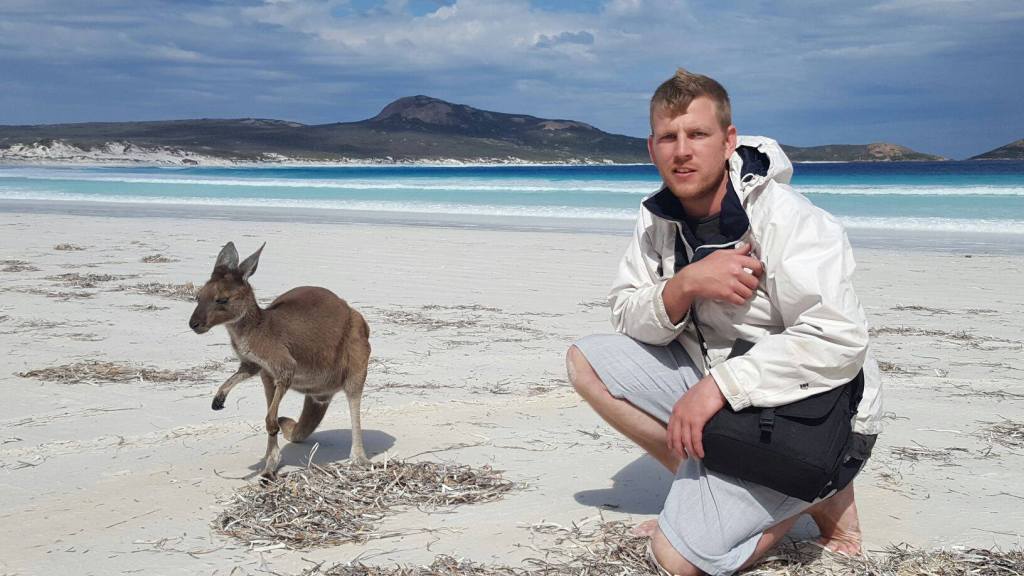
Me and a friendly kangaroo on the beach at Lucky Bay, Cape Le Grand National Park, Western Australia (W. A. Greenly).

Literature Cited:

  1. Royal National Park. (2019). Royal National Park – Royal National Park. [online] Available at: https://www.royalnationalpark.com.au/ [Accessed 19 Sep. 2019].
  2. Parksaustralia.gov.au. (2019). [online] Available at: https://parksaustralia.gov.au/marine/parks/ [Accessed 19 Sep. 2019].
  3. Laurance, W.F., Dell, B., Turton, S.M., Lawes, M.J., Hutley, L.B., McCallum, H., Dale, P., Bird, M., Hardy, G., Prideaux, G. and Gawne, B., 2011. The 10 Australian ecosystems most vulnerable to tipping points. Biological Conservation144(5), pp.1472-1480.
  4. Australian Government Geoscience Australia. (2019). Applying geoscience to Australia’s most important challenges. [online] Available at: https://www.ga.gov.au/scientific-topics/national-location-information/landforms/islands [Accessed 4 Oct. 2019].
  5. Dessler, A.E. and Parson, E.A., 2019. The science and politics of global climate change: A guide to the debate. Cambridge University Press.
  6. Oreskes, N., 2018. The scientific consensus on climate change: How do we know we’re not wrong?. In Climate Modelling (pp. 31-64). Palgrave Macmillan, Cham.
  7. Oreskes, N. The scientific consensus on climate change. Science 306, 1686 (2004).
  8. Anderegg, W. R., Prall, J. W., Harold, J. & Schneider, S. H. Expert credibility in climate change. Proc. Natl Acad. Sci. USA 107, 12107–12109 (2010).
  9. Cook, J., Oreskes, N., Doran, P.T., Anderegg, W.R., Verheggen, B., Maibach, E.W., Carlton, J.S., Lewandowsky, S., Skuce, A.G., Green, S.A. and Nuccitelli, D., 2016. Consensus on consensus: a synthesis of consensus estimates on human-caused global warming. Environmental Research Letters11(4), p.048002.
  10. Zhang, B., van der Linden, S., Mildenberger, M., Marlon, J.R., Howe, P.D. and Leiserowitz, A., 2018. Experimental effects of climate messages vary geographically. Nature Climate Change8(5), p.370.
  11. Australian Government Geoscience Australia. (2019). Applying geoscience to Australia’s most important challenges. [online] Available at: https://www.ga.gov.au/scientific-topics/energy/basics [Accessed 3 Oct. 2019].
  12. Energy.gov.au. (2019). [online] Available at: https://www.energy.gov.au/sites/default/files/australian_energy_statistics_2019_energy_update_report_september.pdf [Accessed 21 Sep. 2019].
  13. Environment.gov.au. (2019). EPBC Act List of Threatened Fauna. [online] Available at: https://www.environment.gov.au/cgi-bin/sprat/public/publicthreatenedlist.pl [Accessed 3 Oct. 2019].
  14. Environment.gov.au. (2019). EPBC Act List of Threatened Flora. [online] Available at: https://www.environment.gov.au/cgi-bin/sprat/public/publicthreatenedlist.pl?wanted=flora [Accessed 3 Oct. 2019].
  15. IUCN. (2019). Biodiversity, it’s now or never. Available at: https://www.iucn.org/content/biodiversity-it%E2%80%99s-now-or-never [Accessed 3 Oct. 2019].
  16. Australia State of the Environment Report. (2019). Key findings. [online] Available at: https://soe.environment.gov.au/theme/biodiversity/key-findings?year=96#key-finding-120181 [Accessed 3 Oct. 2019].
  17. Abs.gov.au. (2019). Population clock. [online] Available at: https://www.abs.gov.au/ausstats/abs%40.nsf/94713ad445ff1425ca25682000192af2/1647509ef7e25faaca2568a900154b63?OpenDocument [Accessed 3 Oct. 2019].
  18. Census.gov. (2019). Population Clock: World. Available at: https://www.census.gov/popclock/world [Accessed 3 Oct. 2019].
  19. Un.org. (2019). World population projected to reach 9.7 billion by 2050 | UN DESA | United Nations Department of Economic and Social Affairs. [online] Available at: https://www.un.org/en/development/desa/news/population/2015-report.html [Accessed 3 Oct. 2019].
Introduction

Let me introduce myself – Short Bio

Please subscribe to receive my latest free readings and my posts about nature & science straight to your email. 🌏👩🏽‍🔬😀

Hi,

I’m W. A. Greenly.

Science geek, Earth lover, and opinionated writer with a Bachelor’s Degree in Biodiversity & Conservation.

However, pre-2018, I was employed as a qualified Mechanic and Service Advisor spending my time in a dirty old workshop waiting for the next broken-down car to be towed in so I could try and make my next big sale.

I had all the normal debt a 28-year-old was supposed to have. A mortgage, a car loan, plus all the normal bills that came with life. Yep, I was well on my way to “success”. Or, so I thought. Really, I was just trapped, working a job I did not enjoy. Would you believe I honestly thought that I was well on my way to achieving happiness?


That happiness, it never came.

I’d tell myself it was always just around the corner. Oh, how wrong I was.

Thankfully, I now realise what I was missing, the joy that comes with having fewer desires and exploring one’s passions! For me, that’s writing and enjoying what so many forget is all around us and free, the natural world!

Join me, follow and like my Facebook page, or wack your email in the subscriber bar below. Share with me all that is natural and beautiful. Exchange knowledge, help nut out worldly issues, or just read my science and nature-based articles. If that’s not for you, check out my fictional stories or learn about the book I’m working on.

This is a place you can read, watch, have fun, and also learn all you want about our Earth.

After all, that is where true happiness lies (for me at least).

Thank you and enjoy,

W. A. Greenly.

Return to my homepage