
Theme: Response, Factual, Opinion.
Reading Time: 4 minutes.
Please subscribe to receive my latest posts about nature & science straight to your email inbox. 🌏👩🏽🔬😀
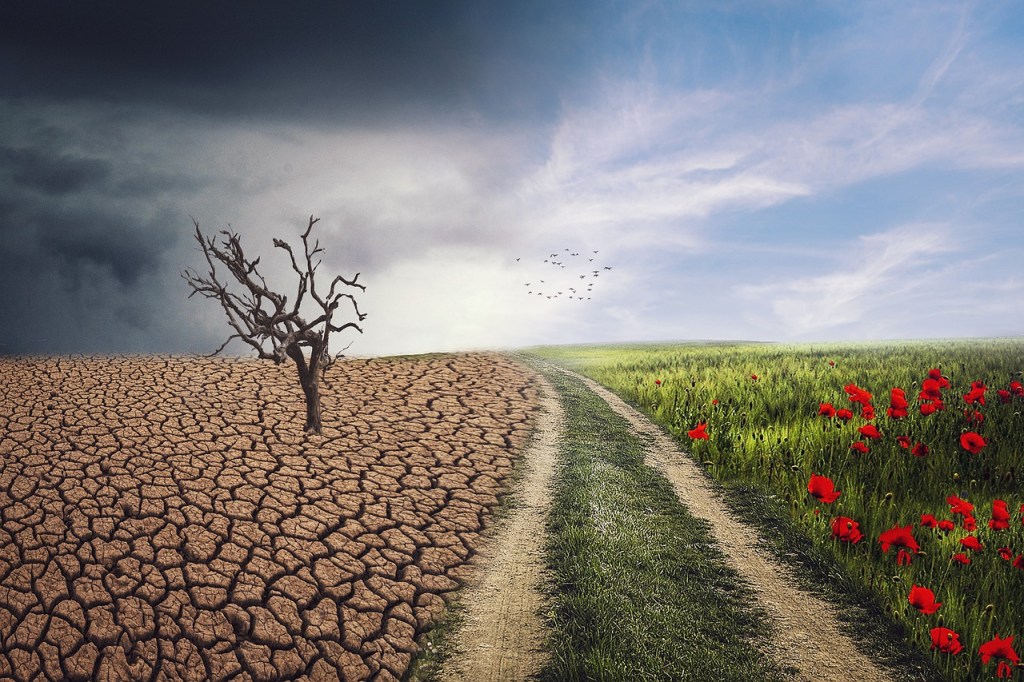
The year is 2019, and in just a few more days it will be 2020. The climate debate, in my opinion, was won and lost years ago. Yet, it seems that a vast majority of the climate change deniers who still dispute the facts and evidence simply don’t know the difference between the weather and the climate.
Some don’t seem to understand that when several towns or cities record a high temperature on the same day, the average national temperature on that same day can still be what is considered normal. To go one step further, the average yearly temperature that surrounded that one day could also be normal, or it may even be colder than usual. I refer to a December 18, 2019 post by Craig Kelly (Liberal Federal Member for Hughes in Sydney’s South) who also refers to a single day’s weather as the ‘climate’ (please continue reading Craig, I am more than happy to be educating you on the difference).
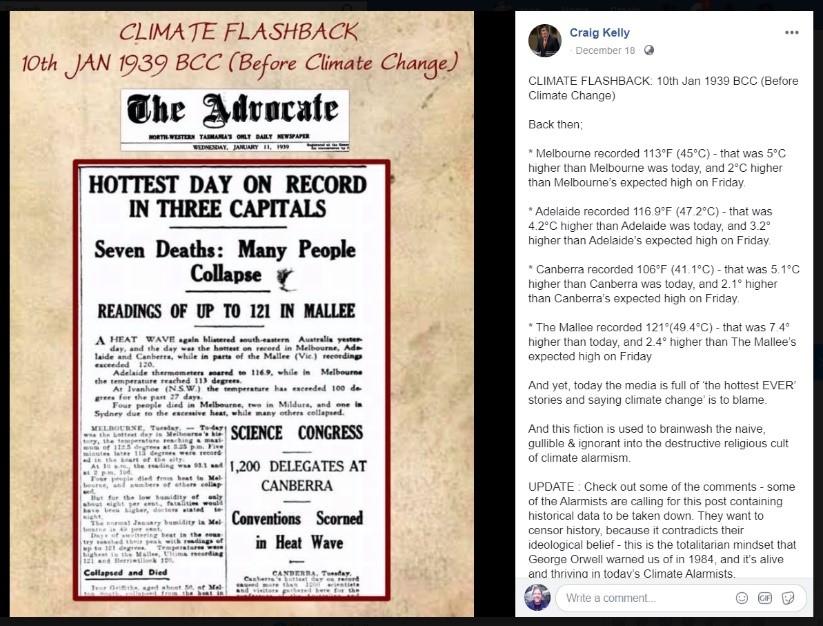
A screenshot of the post by Craig Kelly, December 18, 2019.
Others have labelled their article “50 degrees everywhere, right across Australia in the 1800’s” while presenting a figure that displays only six weather recordings from that century and 15 recordings that are actually from the 1900’s. Six of which are temperatures only in the high 40’s. I refer this time to Joanne Nova, who from what I can see, offers climate change sceptics loose information camouflaged under misleading titles that will surely receive a quick share or stir up an immediate frenzy. People like Joanne aim only to ‘sceptic-monger’.
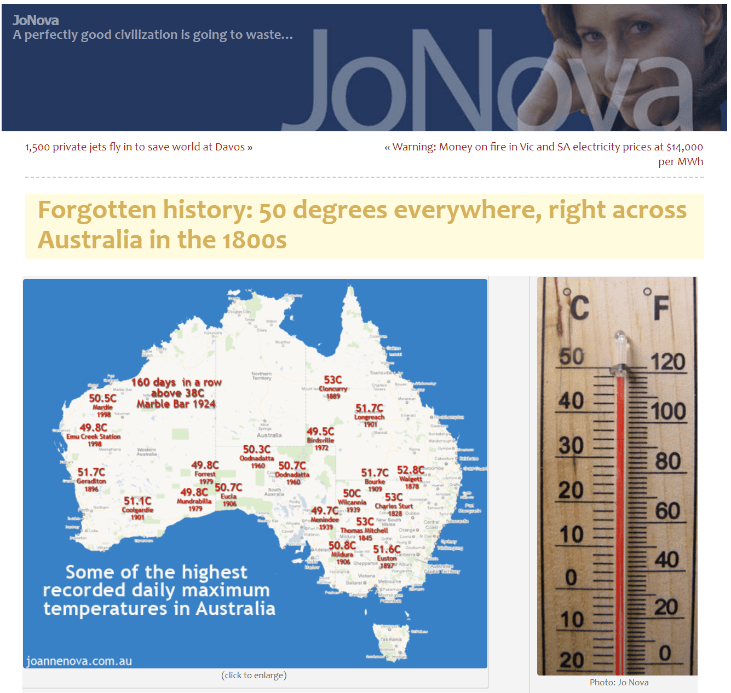
Cutouts from an article by Joanne Nova, January 24, 2019.
So, what’s the difference between climate and weather?
Weather is the state of the atmosphere reported day-to-day (such as those temperatures in Craig Kelly’s and Joanne Nova’s posts). The weather reflects short term changes in atmospherical conditions over small temporal scales, often minutes to weeks. I add, weather is not limited to temperature either.
Climate is the average weather of a certain place over a much larger temporal scale, often 20-30 years. Climate is also not limited to temperature.
So, isolated weather reports (including temperatures) from 50, 100, 200, 1000 or heck, 4 billion years ago, have absolutely nothing to do with the climate what so ever.
When scientists refer to climate change, they refer to the climate in a location i.e. Australia, changing over large temporal periods. This means they may calculate averages of weather conditions such as temperature, humidity, cloudiness, visibility, precipitation and wind within a period of 20-30 years in Australia. Then they compare this 20-30 year block with the following 20-30 year blocks and if they notice ON AVERAGE that the temperature is growing hotter, or there is less precipitation, or perhaps the wind has altered… BAM! That is ‘climate change’.
Fortunately for us, such comparisons have taken place and the information is readily available to anyone. Australia’s climate (average temperature) has warmed by just over 1 °C since 1910, leading to an increase in the frequency of extreme heat events(1).
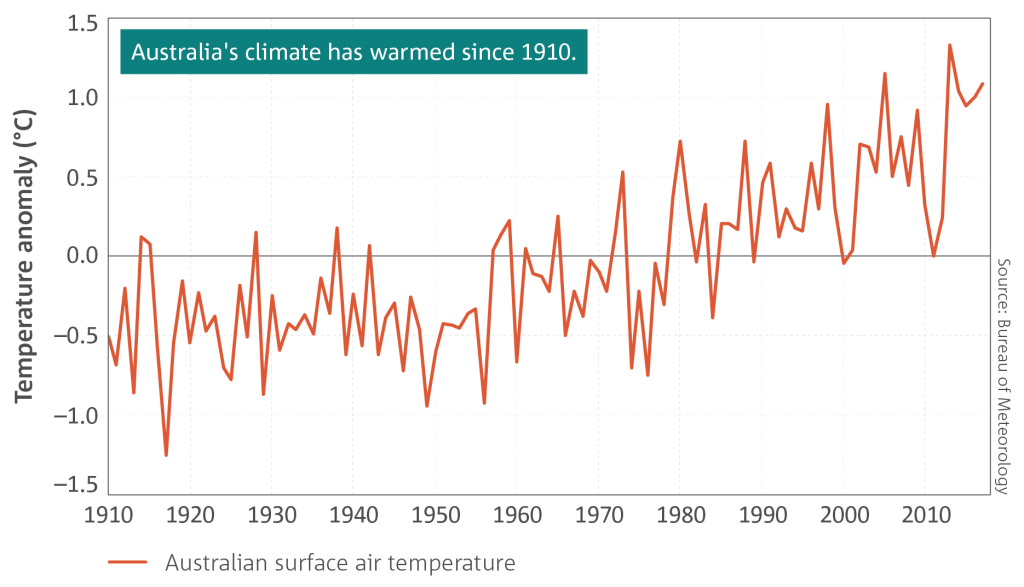
Figure 1: Anomalies in annual temperature over land in the Australian region. Anomalies are the departures from the 1961–1990 standard averaging period (Source: https://www.csiro.au/en/Research/OandA/Areas/Assessing-our-climate/State-of-the-Climate-2018/Australias-changing-climate).

Figure 2: Number of days each year where the Australian area-averaged daily mean temperature is extreme. Extreme days are those above the 99th percentile of each month from the years 1910–2017. These extreme daily events typically occur over a large area, with generally more than 40 per cent of Australia experiencing temperatures in the warmest 10 per cent for that month (Source: https://www.csiro.au/en/Research/OandA/Areas/Assessing-our-climate/State-of-the-Climate-2018/Australias-changing-climate).
For a more in-depth understanding of Australia’s changing climate I encourage you to read the compiled work of the trusted experts here: https://www.csiro.au/en/Research/OandA/Areas/Assessing-our-climate/State-of-the-Climate-2018/Australias-changing-climate
So, that’s it, an undeniable lesson on climate change. If, like me, you’re frustrated by the minority who still deny climate change and can’t tell the difference between climate and weather (as is the case with Craig Kelly and Joanne Nova), I suggest next time you come across a post or article like theirs, which appeals only to the sceptics, take the link of my article and post it in the comments and save yourself the time responding.
Thoughts? Comments? Post them below and I will be sure to respond.
Thank you and enjoy,
W. A. Greenly.
W. A. Greenly’s upcoming articles include:
- The Mystery of the Australian Megafauna.
- Recycling Made Simple.
- The Climate Change Vortex.
Literature cited:
- Csiro.au. (2019). Australia’s changing climate – CSIRO. [online] Available at: https://www.csiro.au/en/Research/OandA/Areas/Assessing-our-climate/State-of-the-Climate-2018/Australias-changing-climate [Accessed 28 Dec. 2019].
 W. A. Greenly.